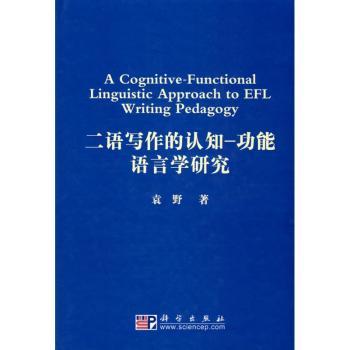
内容简介
《二语写作的认知:功能语言学研究》中的研究以应用、指导价值的语言学分支——认知及功能语言学为强大的理论支撑,建立起了可以整合当前各主要写作研究流派(包括过程写作、产品写作及体裁写作)的认知功能语言学过程写作框架。该框架主要包括可以详细描述从思想产生到词汇语法意象图式形成直至文字产出的全过程的写作模型,还包括用于对写作文本进行语篇分析的分析模式。
目录
前言
Acknowledgements
Abstract
Chapter 1 Introduction
Chapter 2 Review of Literature on Rhetoric and Writing Research
2.1 Introduction
2.2 Product-oriented approaches
2.3 Process-oriented approaches
2.3.1 Pre-writing
2.3.2 Drafting
2.3.3 Rewriting
2.3.4 Other components in Flower and Hayes writing process model (1980)
2.3.5 Verbal protocols——the major means of research within this writing-as-process paradigm
2.3.6 New developments of the Flower-Hayes 1980 model
2.3.7 Instances of writing-as-process model as applied in ESL/EFL writing research
2.4 The process-oriented versus product-oriented writing approaches
2.5 For a comprehensive theory of writing
2.6 A review of major linguistic studies on writing
2.6.1 The transformational-generative approach to writing
2.6.2 Genre and the textlinguistics approach to writing
2.6.3 The application of cognitive linguistics in writing research
2.7 Revisiting the processes in generating the text
2.8 On the social context and attitudes which influence writing (and the writer)
2.9 Review of current college writing textbooks and teaching method
2.10 Application of writing-as-cognitive-functional-linguisticprocess model
Chapter 3 A Theoretical framework for Our Cognitive-Functional Approach
3.1 Theoretical backgrounds
3.1.1 (Transformational) Generative Grammar
3.1.2 Systemic Functional Grammar
3.1.3 Cognitive Linguistics: a general survey
3.2 Some relevant details of cognitive functional linguistic studies
3.2.1 The Billiard-ball model
3.2.2 The Stage model
3.2.3 Transitivity
3.2.4 Grammatical relations
3.2.5 Voice, de/focusing, prominence, and dimensions of specificity
3.2.6 Nominalization and verbalization
3.2.7 Conceptual metaphor and the language of metaphor
3.2.8 Extended image schema theory
Chapter 4 A Cognitive-Functional-Linguistic-Process Writing Model
4.1 Introduction
4.2 A cognitive-functional-linguistic-process writing model
4.2.1 The architecture and working mechanism
4.2.2 A further discussion on EFL writing under our model
Chapter 5 Research Design and Methodology
5.1 Qualitative vs. Quantitative
5.2 Participants
5.3 Treatment and the teaching materials
5.3.1 Treatment
5.3.2 Teaching materials
5.4 Assessment
5.4.1 Quantitative assessment
5.4.2 Qualitative evaluation
5.5 Triangulation
Chapter 6 Statistical Results and Qualitative Analysis
6.1 General introduction
6.2 Marking and its results
6.2.1 Markers and marker training
6.2.2 Presentation of the marking results
6.3 Data treatment
6.3.1 On the conceptual metaphor compositions
6.3.2 On the image schema compositions
6.3.3 On the cognitive grammar compositions
6.4 Summary
6.5 A qualitative analysis of the compositions with cognitive-functional linguistic tools
6.5.1 An Analysis on the trea
摘要与插图
The foundations of cognitive stylistics (also called cognitive poet-ics) are mostly in cognitive linguistics and CL-friendly cognitive psy-chology, which take as their premise that all forms of expression andconscious perception are bound up with our biological endowment.As Stockwell (2002, p.4) puts it, "Most simply, we think in the formsthat we do and we say things in the ways that we do because we areall roughly human-sized containers of air and liquid and with ourmain receptors at the top of our bodies". We can imagine that, evenwith a slightchange in the band of wavelengths that we can see andthe range of sound frequencies that we can hear with our naked eyesand ears, the world would be totally different for us. As cognitive lin-guistics is a branch of functionalism (Langacker, 2001b, p.143), cognitivestylistics also encompasses situational context and socio-cultural con-text, along with personal circumstances.Besides establishing and refining its theoretical framework, cog-nitive stylistics seeks as a top priority to provide insight into theworking mechanism of creative language use in literature and in eve-ryday discourse. Up until now most of its applications have been inhelping readers to understand and appreciate poems, works of fiction,comic strips and advertisements, such as Margaret Freemans cogni-tive stylistic analysis of certain grammatical patterns in the poetry ofEmily Dickinson (1997), Peter Crisps contribution to applying CLtheory in allegory study (2001, 2005), Stockwells study on such issuesas image schemas in science fiction and Shakespeares Macbeth (2002,2003), Turners analysis of Walt Disney classics with blending theory(2006), Seminos analysis of blending and characters mental func-tioning in Virginia Woolfs "Lappin and Lapinova" (2006), OakleysEvent frame and force dynamic approach to rhetorical analysis (2005),and all the papers in the book Cognitive Poetics in Practice edited byGavins & Steen (2003).