内容简介
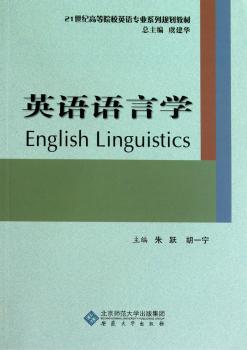
虽然英语语言学对学生学习使用英语有着理论指导意义和实践意义,但是由于种种原因,很多学生认为语言学课程内容抽象、枯燥,对学习英语语言学的兴趣不大,甚至有抵触情绪。要改变这种尴尬的局面,教材的改革十分必要。编者在总结前人英语语言学教材编写经验的基础上,将归纳法引入教材的编写之中,学生通过分析语言事例,去探索、发现、总结语言使用规律,发展理性思维。教材编写强调基础性、实用性、启发性、自足性和时代性;强调理论性与实践性相结合,学术性与趣味性相结合;同时,注重把启发式、讨论式、发现式和研究式的教学理念运用于教材编写之中。
目录
前言
Chapter 1 Introduction
1. What is linguistics?
1.1 Definition of linguistics
1.2 Main branches of linguistics
1.3 Why study language?
2. What is language?
2.1 Definition of language
2.2 Design features of language
3. important distinctions in linguistics
3.1 Prescriptive vs. descriptive
3.2 Synchronic vs. diachronic
3.3 Speech vs. writing
3.4 Langue vs. parole
3.5 Competence vs. performance
Exercises
Further Readings
Chapter 2 Phonetics
1. The phonic medium of language
2. Phonetics
2.1 What is phonetics?
2.2 Organs of speech
2.3 Classification of English speech sounds
Exerc i ses
Further Readings
Chapter 3 Phonology
1. General introduction to phonology
2. Basic concepts of phonology
2.1 Phone, phoneme and allophone
2.2 Phonemic contrast, complementary distribution and minimal pair
2.3 Broad transcription and narrow transcription
3. Some phonological rules
3.1 Sequential rules
3.2 Assimilation rules
4. Suprasegmental features: stress, tone and intonation
4.1 Stress
4.2 Tone
4.3 Intonation
Exercises
Further Readings
Chapter 4 Morphology
1. Morphology
2. Morphemes
3. Types of morphemes
3.1 Free morphemes
3.2 Bound morphemes
4. Allomorph
5. Word formation rules
5.1 Compounding
5.2 Derivation
5.3 Conversion
5.4 Clipping
5.5 Initialism
5.6 Acronym
5.7 Blending
5.8 Back-formation
Exercises
Further Readings
Chapter 5 Syntax
1. Syntactic categories
2. Combinational rules
3. Sentence structure
3.1 The structural approach and IC analysis
3.2 Advantages and problems of IC analysis
3.3 Transformational-generative grammar
4. Universal grammar
4.1 The observational basis of UG
4.2 General principles of UG
4.3 General parameters of UG
Exercises
Further Readings
Chapter 6 Semantics
1. General introduction
2. Approaches to semantics
2.1 The naming theory
2.2 The conceptualist theory
2.3 Contextualism
2.4 Behaviorism
3. Lexical meaning
3.1 Sense and reference
3.2 Major semantic relationships between words
4. Sentence meaning
5. Analysis of meaning
5.1 Componential analysis——a way to analyze lexical meaning
5.2 Predication analysis——a way to analyze sentence meaning
Exercises
Further Readings
Chapter 7 Pragmatics
1. What is pragmatics?
2. Context
3. Entailment
4. Presupposition
5. Speech acts
6. Conversational implicatures
7. The cooperative principle
8. Deixis
9. Politeness principle
Exercises
Further Recld ings
Chapter 8 Language and Society
1. Speech community
2. Relationships between language and society
3. Language varieties
3.1 Dialects
3.2 Register
3.3 Mixture of varieties
Exercises
Further Reedings
Chapter 9 Language and Cultur