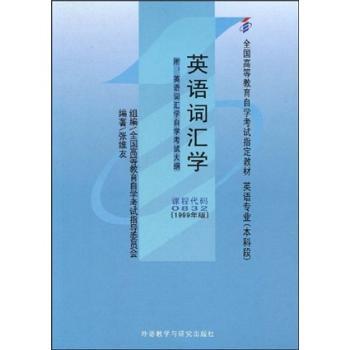
内容简介
当您开始阅读《英语词汇学》时,人类已经迈入了21世纪。这是一个变幻难测的世纪,这是一个催人奋进的时代,科学技术飞速发展,知识更替日新月异。希望、困惑、机遇、挑战,随时随地都有可能出现在每一个社会成员的生活之中。抓住机遇,寻求发展,迎接挑战,适应变化的制胜法宝就是学习——依靠自己学习,终生学习。
目录
Introduction
Chapter 1 Basic Concepts of W0rds and Vocabulary
1.1 What Is a Word
1.2 Sound and Meaning
1.3 Sound and Form
1.4 Vocabulary
1.5 Classification of Words
1.5.1 Basic Word Stock and Nonbasic Vocabulary
1.5.2 Content Words and Functional Words
1.5.3 Native Words and Borrowed Words
Questions and Tasks
Chapter 2 The Development of the English Vocabulary
2.1 The Indo-European Language Family
2.2 A Historical Overview of the English Vocabulary
2.2.1 Old English(450-1150)
2.2.2 Middle English(1150-1500)
2.2.3 Modern English(1500一up to now)
2.3 Growth of Present-day English Vocabulary
2.4 Modes of Vocabulary Development
Questions and Tasks
Chapter 3 Word Formation
3.1 Morphemes
3.2 Allomorphs
3.3 Types of Morphemes
3.3.1 Free Morphemes
3.3.2 Bound Morphemes
3.4 Root and Stem
Questions and Tasks
Chapter 4 WOrd Formation II
4.1 Affixation
4.1.1 Prefixation
4.1.2 Surfixation
4.2 Compounding
4.2.1 Characteristics of Compounds
4.2.2 Formation of Compounds
4.3 Conversion
4.4 Blending
4.5 Clipping
4.6 Acronymy
4.6.1 Initialisms
4.6.2 Acronyms
4.7 Back-formation
4.8 Words from Proper Names
Questions and Tasks
Chapter 5 Word Meaning
5.1 The Meanings of‘Meaning
5.1.1 Reference
5.1.2 Concept
5.1.3 Sense:
5.2 Motivation
5.2.1 onomatopoeic Motivation
5.2.2 Morphological Motivation
5.2.3 Semantic Motivation
5.2.4 Etymological Motivation
5.3 Types of Meaning
5.3.1 Grammatical Meaning and Lexical Meaning
5.3.2 Conceptual Meaning and Associative Meaning
Questions and Tasks
Chapter 6 Sense Relations and Semantic Field
6.1 Polysemy
6.1.1 Two Approaches to Polysemy
6.1.2 Two Processes of Development
6.2 Homonymy
6.2.1 Types of Homonyms
6.2.2 Origins of Homonyms
6.2.3 Differentiation of Homonyms from Polysemant
6.2.4 Rhetoric Features of Homonyms
6.3 Synonymy
6.3.1 Definition of Synonyms
6.3.2 Types of Synonyms
6.3.3 Sources of Synonyms
6.3.4 Discrimination of Synonyms
6.4 Antonymy
6.4.1 Types of Antonyms
6.4.2 Some of the Characteristics of Antonyms
6.4.3 The Use of Antonyms
6.5 Hyponymy
6.6 Semantic Field
Questions and Tasks
Chapter 7 Changes in Word Meaning
7.1 Types of Changes
7.1.1 Extension
7.1.2 Narrowing
7.1.3 Elevation
7.1.4 Degradation
7.2 Causes of Changes
7.2.1 Extra-linguistic Factors
7.2.2 Linguistic Factors
Questions and Tasks
Chapter 8 Meaning and Context
8.1 Types of Context
8.1.1 Extra-linguistic Context
8.1.2 Linguistic Context
8.2 The Role of Context
8.2.1 Elimination of Ambiguity
8.2.2 Indication of Referents
8.2.3 Provision of Clues for Inferring Word-mea
摘要与插图
Etymology is traditionally used for the study of the origins and history of the form and meaningx。Of words.Modern English is de. ried from the languages of early Germanic tribes with a fairlv small vocabulary· We shall study how this small vocabulary has grown in. to a huge modern,Engl!sh vocabulary and explain the changes that have taken place in the forms and meanings of words.semantics lS the study of meanings of different linguistic levels: lexis,yntax’utterance,discourse,etc.But lexieology will focus on the lexical level.The types of meaning and sense relations such as polysemy,homonymy,synonymy,antonymy,hyponymy and semantic field all belong to the scope of semantic study and consti. tute an important part of lexicology.
Stylistics is the study of style.It is concerned with the user,s choices oi linguistic elements in a particular context for speciaI ef. fects. Among the areas of study:lexis, phonology, syntax, graphology’we shall concentrate on lexis,exploring the stylistic values of words.
Lexicography shares with lexicology the same problems:the from,meanm,origins and usages of words, but they have a pragmatic difference.A lexicographer’s task is to recird the lan- guage as it is used SO as to present the genuine picture of Words t0the reader,providing authoritative reference, whereas the studentof lexicology is to acquire the knowledge and information of lexis S0as to increase their lexical awareness and capacity of language use.