内容简介
提醒:目录 导语为中英文对照,其余部分为纯英文。
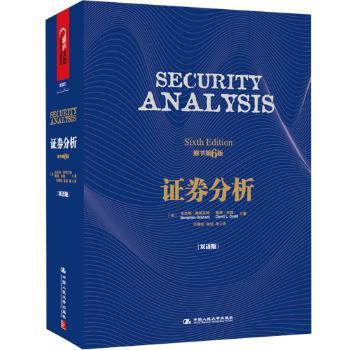
《证券分析》被誉为投资者的圣经,自1934年出版以来,80年不衰。市场反复证明,《证券分析》是价值投资的经典之作。《证券分析》第6版(双语版)是1940年版本的升级版。而《证券分析》1940年版本是作者格雷厄姆和多德的版本,也是股神巴菲特爱的版本。第6版在保持原书原貌的同时,增加了10位华尔街金融大家的导读,既表明了这本书在华尔街投资大师心目中的重要地位,也为这部经典著作增添了时代气息。
《证券分析》的作者本杰明·格雷厄姆是价值投资理论的奠基人,被誉为“华尔街教父”。他既在美国哥伦比亚大学商学院任过教授,又在华尔街创造过辉煌的投资业绩;既经历过让投资者得意忘形的大牛市,又经历过让投资者沮丧绝望的大萧条。市场锤炼了格雷厄姆,也证明了价值投资的意义所在。
《证券分析》第6版(双语版)各章导读源自由经济学家巴曙松老师领衔专业翻译团队,历时一年半,精心打造的*、的中文译本。正如巴曙松老师所言:“历史不会重演,然而总是押着韵脚。当前中国证券市场的转型,同样需要确立价值投资的理念。我决定组织力量翻译《证券分析》第6 版的初衷,也正在于此。”
目录
[目录]
译者序 在中国证券市场转型的过程中重温经典的价值
Foreword
SixthEdition Preface The Timeless Wisdom of Graham and Dodd
Second Edition Preface
First Edition Preface
Six Edition Introduction Benjamin Graham and Security Analysis: The Historical Backdrop
Second Edition Introduction Problems of Investment Policy
PART I SURVEY AND APPROACH
Introduction to Part I The Essential Lessons
by Roger Lowenstein
1. THE SCOPE AND LIMITS OF SECURITY ANALYSIS. THE ConCEPT OF INTRINSIC
VALUE
2. FUNDAMENTAL ELEMENTS IN THE PROBLEM OF ANALYSIS. QUANTITATIVE AND
QUALITATIVE FACTORS
3. SOURCES OF INFORMATION
4. DISTINCTIONS BETWEEN INVESTMENT AND SPECULATION
5. CLASSIFICATION OF SECURITIES
PART II FIXED-VALUE INVESTMENTS
Introduction to Part II Unshackling Bonds by Howard S. Marks
6. THE SELECTION OF FIXED-VALUE INVESTMENTS
7. THE SELECTION OF FIXED-VALUE INVESTMENTS: SECOND AND THIRD PRINCIPLES
8. SPECIFIC STANDARDS FOR BOND INVESTMENT
9. SPECIFIC STANDARDS FOR BOND INVESTMENT (CONTINUED)
10. SPECIFIC STANDARDS FOR BOND INVESTMENT (CONTINUED)
11. SPECIFIC STANDARDS FOR BOND INVESTMENT (CONCLUDED)
12. SPECIAL FACTORS IN THE ANALYSIS OF RAILROAD AND PUBLIC-UTILITY BONDS
13. OTHER SPECIAL FACTORS IN BOND ANALYSIS
14. THE THEORY OF PREFERRED STOCKS
15. TECHNIQUE OF SELECTING PREFERRED STOCKS FOR INVESTMENT
16. INCOME BonDS AND GUARANTEED SECURITIES
17. GUARANTEED SECURITIES (CONTINUED)
18. PROTECTIVE COVENANTS AND REMEDIES OF SENIOR SECURITY HOLDERS
19. PROTECTIVE COVENANTS (CONTINUED)
20. PREFERRED-STOCK PROTECTIVE PROVISIONS. MAINTENANCE OF JUNIOR CAPITAL
21. SUPERVISION OF INVESTMENT HOLDINGS
PART III SENIOR SECURITIES WITH SPECULATIVE FEATURES
Introduction to Part III “Blood and Judgement” by J. Ezra Merkin
22. PRIVILEGED ISSUES
23. TECHNICAL CHARACTERISTICS OF PRIVILEGED SENIOR SECURITIES
24. TECHNICAL ASPECTS OF ConVERTIBLE ISSUES
25. SENIOR SECURITIES WITH WARRANTS. PARTICIPATING ISSUES. SWITCHING AND
HEDGING
26. SENIOR SECURITIES OF QUESTIonABLE SAFETY
PART IV THEORY OF COMMON-STOCK INVESTMENT.THE DIVIDEND FACTOR
Introduction to Part IV Go with the Flow by Bruce Berkowitz
27. THE THEORY OF COMMON-STOCK INVESTMENT
28. NEWER CANONS OF COMMON-STOCK INVESTMENT
29. THE DIVIDEND FACTOR IN COMMON-STOCK ANALYSIS
30. STOCK DIVIDENDS
PART V ANALYSIS OF THE INCOME ACCOUNT. THE EARNINGS FACTOR IN COMMON-STOCK VALUATION
Introduction to Part V The Quest for Rational Investing<
摘要与插图
Introduction to Part ITHE ESSENTIAL LESSonSBY ROGER LOWENSTEIN
I f the modern reader were asked, what did the junk bonds of the 1980s, the dot-com stocks of the late 1990s, and, more recently, the various subprime mortgage portfolios of the 2000s all have in common, the first correct answer is that each of them took a nosedive from a highly inflated price to one rather closer to zero. You can throw in, for good measure, the net asset value and reputation of the world’s most intelligent hedge fund, Long-Term Capital Management (LTCM). The second right answer is that each was an investment disaster whose perils could have been avoided by a patient reading of Security Analysis. Graham and Dodd wrote the first edition in 1934 and first revised it in 1940—some four decades before Michael Milken became a household name and three score years in advance of the frenzy for no-documentation, adjustable-rate mortgages. The authors advocated more than a merely generalized skepticism. They prescribed (as we will see) a series of specific injunctions, each of which would have served as a prophylactic against one or more of the above-named fiascos and their associated investment fads.
While the book was received by serious investors as an instant classic, I cannot say it elevated Wall Street or the public above their tendency to speculate. If I can venture a guess as to why, it is that even the experienced investor is too often like the teenage driver first taking over the wheel. He hears the advice about being careful, avoiding icy patches and so forth, and consigns it to the remote part of his brain reserved for archived parental instructions. He surely does not want to wreck the family car, but avoiding an accident is a low priority because he does not think it will happen to him. Thus with our investor: he is focused on making money, not with averting the myriad potential wrecks in the investment landscape. And I suspect that Graham and Dodd have been ignored by those who suffer from the misconception that trying to make serious money requires that one take serious risks. In fact, the converse is true. Avoiding serious loss is a precondition for sustaining a high compound rate of growth.
In 25 years as a financial journalist, virtually all of the investors of this writer’s acquaintance who have consistently earned superior profits have been Graham-and-Dodders. The most famous, of course, is Warren Buffett, and he is also the most illustrative. Buffett became Graham’s pupil and disciple in 1950, when as a scrawny 20-year-old, he confided to a friend that he would be studying under a pair of “hotshots” (meaning Benjamin Graham and his assistant David Dodd) at the Columbia Business School. 1 And he was also, years later, the first to admit that he had moved beyond the stocks that lay within his master’s ken. Buffett was an adapter; he did not imitate his mentor stroke for stroke. He began wit