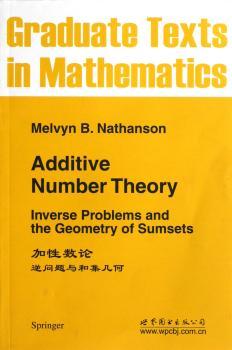
内容简介
《加性数论:逆问题与和集几何》分为上下2卷。堆垒数论讨论的是很经典的直接问题。在这个问题中,先假定有一个自然数集合a和大于等于2的整数h,定义的和集ha是由所有的h和a中元素乘积的和组成,试图描述和集ha的结构;相反地,在逆问题中,从和集ha开始,去寻找这样的一个集合a。近年来,有关整数有限集的逆问题方面取得了显著进展。地,freiman, kneser, plünnecke, vosper以及一些其他的学者在这方面做出了突出的贡献。《加性数论:逆问题与和集几何》中包括了这些结果,并且用freiman定理的ruzsa证明将《加性数论:逆问题与和集几何》的内容推向了高潮。
《加性数论:逆问题与和集几何》读者对象:数学专业的研究生和相关专业的科研人员。
目录
preface
notation
1 simple inverse theorems
1.1 direct and inverse problems
1.2 finite arithmetic progressions
1.3 an inverse problem for distinct summands
1.4 a special case
1.5 small sumsets: the case 2a 3k - 4
1.6 application: the number of sums and products
1.7 application: sumsets and powers of 2
1.8 notes
1.9 exercises
2 sums of congruence classes
2.1 addition in groups
2.2 the e-transform
2.3 the cauchy-davenport theorem
2.4 the erdos——ginzburg-ziv theorem
2.5 vosper's theorem
2.6 application: the range of a diagonal form
2.7 exponential sums
2.8 the freiman-vosper theorem
2.9 notes
2.10 exercises
3 sums of distinct congruence classes
3.1 the erd6s-heilbronn conjecture
3.2 vandermonde determinants
3.3 multidimensional ballot numbers
3.4 a review of linear algebra
3.5 alternating products
3.6 erdos-heilbronn, concluded
3.7 the polynomial method
3.8 erd6s-heilbronn via polynomials
3.9 notes
3.10 exercises
4 kneser's theorem for groups
4.1 periodic subsets
4.2 the addition theorem
4.3 application: the sum of two sets of integers
4.4 application: bases for finite and a-finite groups
4.5 notes
4.6 exercises
5 sums of vectors in euclidean space
5.1 small sumsets and hyperplanes
5.2 linearly independent hyperplanes
5.3 blocks
5.4 proof of the theorem
5.5 notes
5.6 exercises
6 geometry of numbers
6.1 lattices and determinants
6.2 convex bodies and minkowski's first theorem
6.3 application: sums of four squares
6.4 successive minima and minkowski's second theorem
6.5 bases for sublattices
6.6 torsion-free abelian groups
6.7 an important example
6.8 notes
6.9 exercises
7. plunnecke's inequality
7.1 plunnecke graphs
7.2 examples of plunnecke graphs
7.3 multiplicativity of magnification ratios
7.4 menger's theorem
7.5 pliinnecke's inequality
7.6 application: estimates for sumsets in groups
7.7 application: essential components
7.8 notes
7.9 exercises
8 freiman's theorem
8.1 multidimensional arithmetic progressions
8.2 freiman isomorphisms
8.3 bogolyubov's method
8.4 ruzsa's proof, concluded
8.5 notes
8.6 exercises
9 applications of freiman's theorem
9.1 combinatorial number'theory
9.2 small sumsets and long progressions
9.3 the regularity lemma
9.4 the balog-szemeredi theorem
9.5 a conjecture of erd6s
9.6 the proper conjecture
9.7 notes
9.8 exercises
references
index
摘要与插图
版权页:
Let T be a set that separates a from b in the graph H, and suppose that a, b ∈/ T. Let π be a path from a to b in G, and let π` be the terminal segment of this path that belongs to P(S, b). Then π` is a path from some s ∈ S to b. Since (a, s) is an edge in H, it follows that a, s concatenated with the path π` is a path in H from a to b. Since T separates a from b in H, it follows that T contains an intermediate vertex of this path, and so either s ∈ T or some intermediate vertex of π` belongs to T. Thus, T also separates a from b in G. Therefore, |T| ≥ ι. Since the graph H contains strictly fewer vertices than the graph G, it follows from the induction hypothesis that there are ι pairwise disjoint paths in H from a to b. In particular, for each s ∈ S there exists a path π2(s) ∈ P(S, b) from s to b such that the ι paths π2(s) are pairwise disjoint.