内容简介
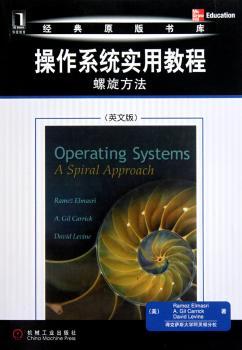
《操作系统实用教程:螺旋方法(英文版)》采用螺旋方法和深度导向方法讲解操作系统原理。先介绍一些基本的背景和定义,然后描述一个简单的操作系统,之后将它演化为具有更多特性的更复杂的操作系统。这样循序渐进、逐步深入,可以使学生更透彻地理解操作系统的本质。
《操作系统实用教程:螺旋方法(英文版)》分为六个部分:第一部分介绍一些总体背景信息;第二部分采用螺旋方法,按照复杂度递增的次序。介绍五类操作系统;第三部分到第五部分采用深度导向方法详细地探讨操作系统的各个主题:从进程到内存管理,再到文件系统;第六部分通过三个实例更深入地研究这些系统的特性是如何实现的。
目录
Preface vi
Part 1 Operating Systems Overview and Background
Chapter 1
Getting Started
1.1 Introduction
1.2 What Are Operating Systems All about?
1.3 User veusus System View of an OS
1.4 Some OS Terms. Basic Concepts, and Illustrations
1.5 A Small Historical Diversion
1.6 Summary
Chapter 2
Operating System Concepts, Components and Architectures
2.1 Introduction:What Does the OS DSs
2.2 Resources Managed by the OS and Major OS Modules
2.3 The Process Concept and OS Process Information
2.4 Functional Classes of OSs
2.5 Architectural Approaches to Building an OS
2.6 Some OS Implement Techniques and Issues
2.7 Minimalist versus Maximalist Approaches to OS Functionality and Back ward Compatibility
2.8 Summary
Part 2
Building Operating Systems Incrementally:A Breadth-Oriented Spiral Approach
Chapter 3
A Simple,Single-Process Operating System
3.1 Introduction:Monitors and CP
3.2 Characteristics of a Simple PC System
3.3 Input Output Management
3.4 Disk Management and the File System
3.5 Process and Memory Manage me
3.6 Summary
Chapter 4
A Single-User Multitasking
Operating System
4.1 Introduction:A Simple Multitasking System
4.2 The Palm OS Environment and System Layout
4.3 Process Scheduling and System Layout
4.6 Basic Input and Output
4.7 Display Management
4.8 Event-Driven Programs
4.9 Summary
Chapter 5
A Single-User Multitasking/Multithreading Operating System
5.1 Introduction 89
5.2 The Origin of the Macintosh Computer
5.3 The Macintosh OS——System
5.4 System2
5.5 System3
5.6 System4
5.7 System5
5.8 System6
5.9 System7
5.10 System8
5.11 System9
5.12 Mac OS X
5.13 Summary
Chapter 6
A Multiple-User Operating System
6.1 Introduction
6.2 The Multiuser OS Envtronment
6.3 Processes and Threads
6.4 Summary
Chapter 7
Parallel and Distributed Computing, Clusters, and Grids
7.1 Introduction
7.2 Key Concepts
7.3 Parallel Distributed Processing
7.4 Distributed System Architectures
7.5 How Operating System Concepts Differ in SMPs, Cluster, and Grids
7.6 Examples
7.7 Summary
Part 3
CPU and Memory Management
Chapter 8
Process Management: Concepts, Threads, and Scheduling
8.1 Introduction to Processes
8.2 Process Descriptor-Processes Control Block
8.3 Process States and
8.4 Process Scheduling
8.8 0ne Good Process Deserves Another
8.6 Threads
8.7 Case Studies
8.7 Summary